Bart de Pau Language Courses – Levels
Level assessment
HOW TO DETERMINE YOUR LEVEL?
Step 1: Take this multiple-choice test. You can skip this step if you are 100% certain that you are at A2 level or higher.
Step 2: If the result is A2 or higher, take this fill-in-the-gap test.
Step 3: If the result indicates Level 4 or higher, contact us for a speaking assessment. You can call us any day of the week between 10:00 and 22:00 at +31 6 48074618.
You should also contact us for a level consultation or speaking assessment before booking if:
- You are unsure about your level.
- Your test result differs from the level you would like to book.
- You plan to study extensively before the course and would like to discuss what is realistic and achievable.
Please note: The level assessment is not optional. The only choice you have is whether to complete it before booking or no later than one month before the course.
LEVEL ASSESSMENT = MANDATORY
- The student (except for total beginners) must complete the level assessment no later than one month before the course, or before booking if the booking is made less than one month before the course.
- The level assessment must confirm that the student meets the minimum required entry level for the course booked.
- If the assessment indicates that the student is at a different level, the course can be rescheduled upon request, provided the request is made more than one month before the course (see rescheduling terms).
- The assessment requirements for each level are as follows:
Level 1: No test is required for total beginners. If the student has some prior knowledge of Dutch, this test is recommended.
Level 2: The multiple-choice test is mandatory. If the test does not confirm Level 2, a level consultation by phone* is mandatory.
Level 3: The multiple-choice test is recommended. The fill-in-the-gap test is mandatory. If the test does not confirm Level 3, a level consultation by phone* is mandatory.
Levels 4, 5, 6, R: The fill-in-the-gap test is mandatory, followed by a speaking assessment by phone*.
* Call us any day between 10:00 and 22:00 at +31 6 48074618.
Bart de Pau levels vs A1/A2/B1/B2
CEFR
CEFR stands for the Common European Framework of Reference for Languages. It distinguishes six language proficiency levels: A1, A2, B1, B2, C1, and C2. It is a framework for describing how well someone can communicate in a (foreign) language. Many language schools and textbooks use this classification.
However, the steps between CEFR levels are not equal in terms of study load.
Vocabulary size illustrates this difference. For example:
- A1: approximately 1,000 words
- A2: approximately 2,000 words
- B1: approximately 4,000–5,000 words
- B2: approximately 8,000–10,000 words
As a result, progressing from B1 to B2 generally requires considerably more study time than progressing from A1 to A2.
OUR LEVELS
Because we organise intensive 9-day courses, we have developed our own level system. We have divided the entire journey from beginner level to B2 into approximately equal parts in terms of study load.
Each level corresponds to one intensive Dutch course of 9–10 days of classes. The levels are consecutive, and each builds on the previous one. You can find the descriptions of our levels below.
- From 0 to A1 → Level 1
- From A1 to A2 → Level 2
- From A2 to B1 → Levels 3 + 4 (+ real-life speaking experience)
- From B1 to B2 → Levels 5 + 6 + R (+ real-life speaking experience)
NOTICING IMPROVEMENT
When you progress from A1 to A2, you will notice a significant improvement. You will roughly double your vocabulary and learn frequently used words and basic grammatical structures that occur in almost every sentence. You will feel that you are making a lot of progress.
Progress at higher levels feels different. Once you reach B1, you might expand your vocabulary by just 10–15% during a single course. You will also encounter more exceptions and nuances rather than learning straightforward rules. As a result, you may feel that you are making less progress.
However, that does not mean that the step you take in a single course is any smaller!
DIFFERENT SCHOOLS, DIFFERENT PROGRAMMES, DIFFERENT DEFINITIONS
Not all language schools use exactly the same definitions of A1, A2, B1, and B2. These qualifications are, by their nature, relatively broad.
We cover slightly more material at the A1 and A2 levels than many other schools because our programme is tailored to highly educated learners, who often have more ambitious long-term language goals.
As a result, our level definitions are relatively conservative, whereas other language schools may use a more optimistic classification.
For example, a level that another school calls B1 might be classified as A2+ in our system.
This is why our level assessment is mandatory: it helps us identify which of our levels is the best fit for you.
Level descriptions & course content
LEVEL DESCRIPTIONS
| COURSE | ENTRANCE LEVEL DESCRIPTION | COURSE OBJECTIVES |
|---|---|---|
| LEVEL 1 – Total beginner (from 0 tot A1) |
Entrance level = 0: You have never studied Dutch. Or you have done an introduction course up to A1 level, but you don’t master the content. Do the level test to see if you are not over-qualified for this level. | Target level = A1.At this level we do lessons 1-9 from ‘Het Lesboek-1’.
Table of contents + introduction + lesson 1: click here. Course objectives: click here to see the ‘review’ pages at the end of this level. |
| LEVEL 2 (from A1 to A2) |
Entrance level = A1: You score at least (close to) level 2 in this test. You have completed an introduction course up to A1 level, where you spent at least 60-100 hours* on studying (including self-study). It is important that you really master the content of that course (‘doing a course’ is not the same as ‘mastering the content’!). You can do this level too, if you master the content of Bart de Pau’s online course #dutchgrammar (part 1) in combination with ‘1000 most common words in Dutch’ (both available on learndutch.org).Required prior knowledge: you need to know at least 750-1000 words and the basic elements of grammar, such as: conjugation of verbs, main clause word order, inversion word order, structure of questions, plural nouns, possessive adjectives, modal verbs, comparative, diminutive, behaviour of adjectives with de/het words, (present) perfect tense.
Skills: you can understand very basic phrases. You can introduce yourself. You can ask and answer questions about personal details. You can can interact in a simple way (saying what you want, need) provided the other person talks slowly and clearly and is prepared to help. Is it a problem if you have no real experience speaking Dutch? It’s OK if your knowledge is still ‘passive’. In short: you’ll need to choose the right answer from a multiple choice question, but we understand that applying all elements of the basic grammar correctly in a split-second is still a challenge. Reference 1: if your introduction course was a self study program like Rosetta Stone, Pimsleur or Duolingo; that’s in itself not enough to enroll at this level successfully, because these programs do not cover the required grammar. This can be compensated by completing #dutchgrammar part 1. Reference 2: is it some time ago you did the introduction course? Then make sure you review all the materials in advance! Reference 3: if you studied with ‘Nederlands in Gang’ before: have you come halfway (until chapter 9) and you master the first half of the book really well, then this is the right level to book. Have you completed the book but you don’t really know the content well: then this is the right level to book (instead of level 3). Reference 4: Have you completed the ‘Inburgeringsexamen buitenland’ (the exam of the Dutch embassy/consulate at A1 level), then please be advised that level 2 might be too hard. The reason: the materials for this specific exam do not cover too much of grammar. You might compensate this by completing the online course #dutchgrammar-1. Reference 5: Are you somewhere between A1 and A2 level, and learning for your Inburgering-exam (and having passed perhaps some, but not all of the A2 components) then this is the right level to book. |
Target level = A2.At this level we’ll cover lessons 10-18 from ‘Het Lesboek-1’.
Table of contents + introduction + lesson 10: click here. Course objectives: click here to see the ‘review’ pages at the end of this level in the book. |
| LEVEL 3 (from A2 to A2+) |
Entrance level = A2. You have completed a course up to level A2, where you spent at least 100-200 hours* on studying (including self-study). Preferably, you have some speaking experience in a Dutch environment.Knowledge: you know at least 1500-2000 words. Apart from the required basic grammar as specified for the previous level, you know: separable verbs, reflexive verbs, combinations of verbs and prepositions, the imperative, special verb constructions (‘te’ + infinitive, ‘aan het’ + infinitive), simple past tense, future tense, subclause word order.Skills: apart from the extra required prior knowledge (vocabulary and grammar), the difference with the previous level is that you should be able to apply the basic grammar in speech. So, the knowledge that is specified as required knowledge for level 2, you need to be able to apply actively. Please note the difference between ‘active’ and ‘passive’ knowledge: ‘passive’ knowledge = you’re able to choose the right answer from multiple choice questions; active knowledge = you’re able to use it). Generally, this means that speaking experience in a Dutch environments is required OR the A2 course that you did before included a lot of speaking exercises.
Reference 1: For most people it will be difficult to reach the required entry level with only self-study as prior learning. Starting from scratch and only studying online (without interaction with a teacher or Dutch people) will not bring everyone to level A2. Doing Bart de Pau’s online courses #dutchgrammar-1 + #dutchgrammar-2 + 1000 most common words in Dutch will provide you with the required passive knowledge. However, you’ll need to find a way to practise (speaking with Dutch people). Exception: if you’re a talent or native speaker of German or a Scandinavian language, you might reach A2 level with only online learning. Reference 2: If you finished the following frequently used books ‘Nederlands in Gang’, ‘De Opmaat’, ‘Contact’ in a group course (not self study!), you should subscribe for this level. Reference 3: If you have passed all the elements of the ‘inburgering’ exam at A2 level and you managed to keep the level, then this is the right level to book. If it’s a long time a ago and you didn’t speak or learned Dutch after passing the exam, then it’s strongly recommended to do the level test. |
Target level = A2+ At this level we’ll cover lessons 1-9 from ‘Het Lesboek-2’. Table of contents + introduction + lesson 1: click here. Course objectives: click here to see the ‘review’ pages at the end of this level in the book. |
| LEVEL 4 (from A2+ to B1) |
Entrance level = A2+. Prior study: you have completed one or more courses with a total study load of at least 180-250 hours* (including self study), and preferably a significant amount of speaking experience. Knowledge: you know at least 2500-3000 words. Apart from the required basic grammar as specified for the previous 2 levels, you know 5 uses of the word ‘er’, the modal verb ‘hoeven’ and more detailed some earlier discussed subjects: (in)separable verbs, reflexive verbs (by accident), exceptions of: adjectives and plural nouns, more detailed us of imperative, modal verbs, demonstrative pronouns, special verb constructions.The main difference between this level and the previous level is that here you should be able to apply all basic grammar (as specified for the previous levels) actively in speech. A person on this level is able to quickly construct sentences (without thinking) and can say things in different ways (though: there still will be a lot of mistakes in speaking). Typically, the student on this level has reviewed the vocabulary and grammar of the previous levels several times. The knowledge has reached the ‘long term’ memory.
Good to know 1: Have you previously done a course up to level A2? It might be tempting to choose this level, because ‘A2’ is in our level description. What is important to know is that there is a gap between finishing frequently used books as ‘Nederlands in Gang’, ‘De Opmaat’ and ‘Contact’ and this level. For most students it will be better to subscribe to our level 3, unless you’re very talented or have a lot of speaking experience. |
Target level = B1. At this level we’ll cover lessons 10-18 from ‘Het Lesboek-2’. Table of contents + introduction + lesson 10: click here. Course objectives: click here to see the ‘review’ pages at the end of this level in the book. |
| Level 5 (B1/B2 part 1) |
Anyone in the range B1-B2 can participate in this course.The minimum entrance level = B1: to get the B1 level you have completed more courses with a total study load of at least 250-400 hours* (including self study) and you have a significant amount of speaking experience, preferably an equal amount as the amount of study.
Knowledge: you know at least 4000-5000 words. You can apply the grammar as specified in levels 1-4. You know more complicated grammar constructions, like the past perfect, the relative sub clause and complicated constructions with multiple verbs. And you can apply all functions of “er” without thinking. You know common expressions. Important to understand: you can’t go from level B1 to B2 in one course! The journey from B1 to B2 is a much bigger step (in time and efforts) than going for example from A1 to A2. This is a course on the B1/B2 level rather than from B1 to B2. In order to reach B2 level you need multiple courses and above all: lots and lots of real life speaking experience (preferably 3-6 months speaking Dutch full time in a Dutch environment from the moment you reached B1 level). That is why we offer this level, as level 5, 6 and R. |
Target level = B1+/B2 At this level we’ll cover lessons 1-9 from ‘Het Lesboek – deel 3’.(we’ll add the table of contents later – the book is almost finished) |
| Level 6 (B1/B2 part 2) |
Level 6 has the same entrance level as level 5. The minimum entrance level = B1. But the topics that we discuss in level 6 are a continuation of level 5, therefore this level can only be enrolled if you have completed level 5. | Target level = B1+/B2 At this level we’ll cover lessons 10-18 from ‘Het Lesboek – deel 3’.(we’ll add the table of contents later – the book is almost finished) |
| Level R (B1/B2 for ‘returners’) |
B1/B2. You have completed our previous 6 levels or you have completed courses elsewhere that brought you to a level between strong B1 and B2. Knowledge: you know at least 4000-5000 words. You know more complicated constructions like the passive voice and ‘zouden’.As mentioned above: to reach B2 you need multiple courses on this level (and real life practise). A single course or a single book can never bring you from B1 to B2.
There are a lot of students who have gone through levels 1-6 and want to return at a later stage to continue to study with us: to refresh, review and further improve their knowledge of Dutch and to complete the journey from B1 to B2. At this level, it’s not about learning new grammar. It’s all about applying well what we taught (on the levels 1-6). And we’ll cover lots of different themes during the course to build your vocabulary and language knowledge around specific topics. We’ll alternatively use the books ‘Nederlands op Niveau’ and ‘De Finale’ and cover half the book during one course. B2 level corresponds to a total active knowledge of around 10,000 words. In every level you learn around 1000 new words (in a context). Have you completed levels 1-6 and additionally you did the 4 level R courses. And have you spoken a lot of Dutch in your daily life. Then you’re likely to have reached the B2 level! |
During one course we’ll alternatively cover one of the following (parts of the) books: ‘Nederlands op Niveau’ – first half ‘Nederlands op Niveau’ – second half ‘De Finale’ – first half ‘De Finale’ – second halfTarget level if you do all the levels R = B2. |
| Level R (B2/C1 for ‘returners’) |
B2/C1. You have at least B2 level, either by doing courses at our school or elsewhere. You have an active knowledge of around 8,000-10,000 words.
It’s important to realise that you can never go in one or two courses from B2 to C1 level. The amount of vocabulary that corresponds to C1 level is approximately 20.000 words, whereas B2 level corresponds to 10,000 words. You go to C1 mainly by living in a Dutch speaking environment, speaking only in Dutch, for many years. So what is this course about? The benefit of doing courses at the B2/C1 level is that you continue to build your knowledge of advanced Dutch: complicated structures, complicated texts, complicated themes and conversation topics. It’s not from B2 to C1 but a course that can lift the knowledge of anyone who is somewhere between B2 and C1 level. |
During one course we’ll alternatively cover one of the following (parts of the) books: ‘Nederlands naar Perfectie’ – first half ‘Nederlands naar Perfectie’ – second half. No target level: elevating language skills of anyone between B2 and C1 level. |
* the amount of hours of study: based on higher educated learners, who have experience in learning foreign languages; if you are a slow learner, if you have never learned a foreign language, if you didn’t have grammar education in school, it might take a higher time investment to reach the mentioned level
Course results & target level
TARGET LEVEL
The target level is the level we aim to help you achieve by the end of the course.
It is not a guaranteed outcome that every student will achieve. Your progress depends on your individual efforts. If you attend all the lessons, complete all the homework, learn all the vocabulary, and are able to apply the grammar rules, you will have achieved the target level.
It is important to realise that most students need 3–5 days after the course to review the materials before they can be said to have mastered the content.
PERSONAL FACTORS
Some students learn faster than others. Your progress depends on a variety of personal factors.
Positive factors:
- You speak German, a Scandinavian language, or Afrikaans.
- You have a natural talent for learning foreign languages.
- You speak Dutch frequently outside the classroom.
- You attend all the lessons and complete all the homework.
- You spend extra time reviewing the course materials after the course. (Learning a language is not just about learning new things; you also need to review what you have learned before!)
Negative factors:
- Your entry level is below the required level at the start of the course.
- You have never studied another foreign language before.
- It has been a long time since you last studied Dutch. (You may have previously reached the required entry level but forgotten a lot since then.)
- You have never received formal grammar instruction at school, either in your own language or in another language.
- You have too many distractions or other demands in your daily life to maintain the necessary focus.
- You do not complete all the homework.
- You skip lessons.
- You do not meet the student requirements.
CERTIFICATE
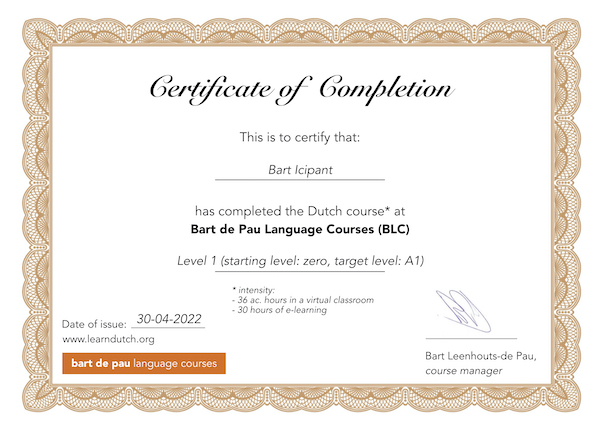
The certificate is issued based on attendance and completion of the self-study materials. To receive a certificate, you must attend at least 80% of the lessons.
Example:
Booking multiple levels
If you plan to book multiple courses
As explained in Course Results & Target Level, it is important to keep the following in mind:
- Completing a course is not the same as mastering the material. Reaching the target level requires more than simply attending the lessons.
- Most students need an additional 3–5 days to review and consolidate the course material before they are ready to move on to the next level.
- Every student has a different learning pace. Some students need more time than others to master the material.
- Your level assessment must confirm that you meet the required entry level for the course you wish to book.
Please take these points into account when planning and booking multiple courses.
Our Recommended Approach
We recommend following these steps:
- Book one course.
- Complete the course.
- Spend 3–5 days reviewing and consolidating the course material.
- Take the level assessment again.
- Book the next level once the assessment confirms that you are ready.
If you need to book multiple courses in advance
We understand that there may be good reasons to book two or more courses in advance. Perhaps you have a budget that needs to be used before the end of the year, or you are travelling from the other side of the world and would like to attend several courses during your stay.
In that case, the following tips may help you plan your courses more effectively.
Booking courses with more than a month between them
The safest option is to schedule your courses at least one month apart.
This gives you time to complete a course, review the material and take the level assessment again before deciding whether to move on to the next level.
If the assessment shows that you are not yet ready for the next course, you can make use of our free rescheduling option, which is available if you do not meet the required entry level one month before the course starts.
Booking courses with less than a month between them
If you would prefer to take courses closer together, it is essential to have your level assessed properly and to discuss your plans with us during the level consultation call. This allows us to help you determine what is realistic and what is not.
Summer School: Booking Consecutive Courses
During the summer, we organise six consecutive course periods. One group departs on the day the next group arrives, so it may be tempting to book two consecutive levels.
We strongly advise against booking two different levels back-to-back. You will not have the recommended 3–5 days to review and consolidate the material, which increases the risk of falling behind.
If you would like to attend multiple Summer School courses, we recommend one of the following options:
- Option 1 – Plan a break between courses: Book your courses with a break of at least 10–20 days in between. This gives you time to review the material and prepare for the next course.
- Option 2 – Attend consecutive courses at the same or a lower level. In some situations, it is possible to attend two courses without a break. If you would really like to spend more than 10 consecutive days at the campus, consider repeating a level or combining a lower level with the level indicated by your assessment.
For example:
- If your level assessment indicates that you are ready for Level 3, you could book Level 2 + Level 3.
- Alternatively, you could book Level 3 + Level 3 to consolidate your knowledge before moving on.
This way, you can continue learning intensively while reducing the risk of falling behind or missing essential knowledge.
Virtual Classrooms
We have planned our virtual classroom schedules with a short break between consecutive levels, allowing students time to review and consolidate what they have learned.
Typically, there is one week between the last lesson of one level and the introductory lesson of the next level. The first regular lesson takes place one week after the introductory lesson.
This means that you will have at least two weeks between courses to review and consolidate the material from the previous course.
Good to know
Repeating a level is not a failure. In language learning, reviewing and consolidating knowledge is often more valuable than progressing too quickly!
Always contact us as soon as possible. If you feel that your original study plan may be too ambitious, please contact us in good time. The earlier you contact us, the more options we may have to find a suitable solution.
For example, we may be able to waive rescheduling costs if:
- A different level on the same course dates still has available places.
- A group is fully booked and someone on the waiting list is willing to take your place.
Please do not wait until the last minute to contact us. The earlier we know about your situation, the better we can help.
Switching levels after booking
More than 1 month before the course
The level assessment must be completed no later than 1 month before the start of the course. If you book a course less than 1 month before it starts, you must complete the level assessment before booking.
If your level assessment shows that you are not yet ready for the level you booked, you can reschedule your course free of charge, provided you request the change more than 1 month before the course starts.
If the level you need is not available on the same course dates, you can reschedule to a different course date.
Changing levels less than 1 month before the course
What if you want to change levels less than 1 month before the course starts, for example because you did not complete the level assessment in time?
If there is availability at the other level and your level assessment confirms that you meet the entry requirements, you can change levels free of charge.
If there is no availability at the other level on the same course dates, our regular rescheduling terms apply, as explained here. Additional costs apply.
Changing levels after the course has started
It is not possible to change levels or courses after the course has started. Your level should be determined before the course begins through the level assessment and, where applicable, an oral intake.
This policy helps us create a stable and positive group atmosphere. If students were able to switch levels freely during a course, it could disrupt the learning process and affect the entire group.
